Available Programs and Supports
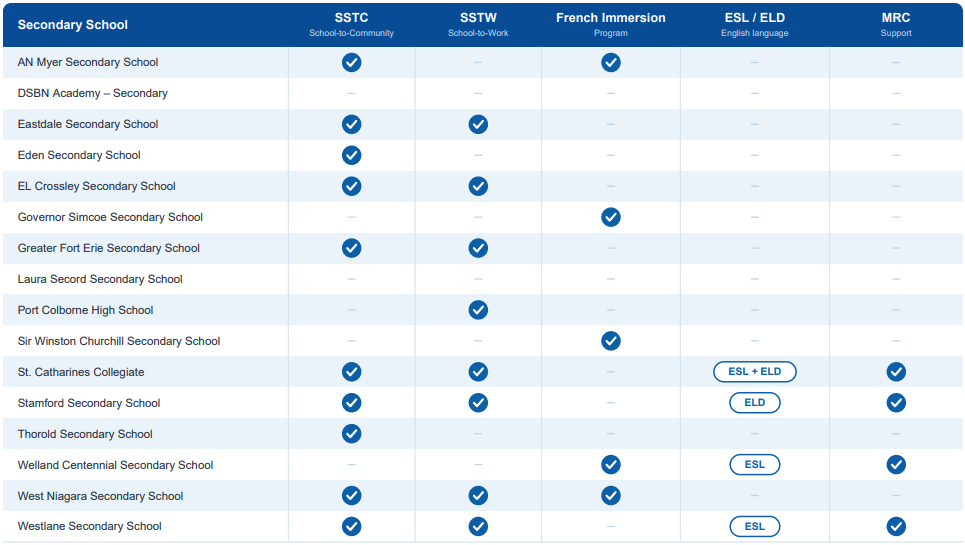
Understanding the Programs
What each program means, and how Grade 9-12 pathways work
SSTC: School-to-Community
- Individualized programming that builds independence, self-advocacy, community participation and life skills.
- Designed to help students reach meaningful personal, community and transition goals beyond secondary school.
- Placement is decided through a central planning process that considers strengths, needs transition goals and available program supports.
SSTW: School-to-Work
- Highly individualized programming that builds employability, independence, life and community skills.
- Learning is designed around each student’s strengths, interests, goals and transition planning for life beyond secondary school.
- Students work toward an Ontario Secondary School Diploma (OSSD) and may access employment and/or college programs that accept workplace-level courses or require an OSSD without specific course prerequisites.
French Immersion
- French Immersion supports students in developing confidence and proficiency in French while completing the Ontario curriculum. French is the language of instruction in French Immersion courses.
- Students who successfully complete a minimum of 10 French Immersion courses between Grades 9 and 12 earn a DSBN French Immersion Certificate.
- French Immersion eligibility: Students must meet the required French instructional hours or receive principal approval to enter the program.
ESL: English as a Second Language
- ESL programming supports multilingual learners who are developing proficiency in English. Students working within STEP 1–4 may benefit from targeted language instruction and supports while continuing to access curriculum, pathway opportunities, and school experiences alongside their peers.
- ESL is not a self-contained program. Students take ESL alongside other secondary courses that contribute toward their OSSD. ESL programming strengthens the academic English skills needed for success in secondary school and helps students prepare for future postsecondary opportunities. Taking ESL does not prevent students from applying to college or university; students continue to build an appropriate pathway toward the admission requirements for their chosen program.
ELD: English Literacy Development
- ELD programming supports multilingual learners who are developing proficiency in English and may require additional support in building foundational literacy and school-learning skills. Some students may have experienced interrupted or limited formal schooling opportunities prior to arriving in Canada. Students working within STEP 1–4 may benefit from targeted language instruction and supports while continuing to access curriculum, pathway opportunities, and school experiences alongside their peers.
- ELD is not a self-contained program. Students typically take one credit-bearing ELD course each semester in addition to other secondary courses that contribute toward Ontario Secondary School Diploma requirements.
Grade 9–12 Pathway Programming
Secondary programming offers flexible pathways through destreamed, locally developed, workplace, college, university and mixed-level courses. Students are supported in exploring their strengths, interests, goals and future opportunities as they progress.
Grade 9
Destreamed and locally developed courses
Grade 10
Academic, applied, destreamed, locally developed and open level courses
Grade 11 & 12
College, mixed level (college/university), open level, university, and workplace preparation courses